
Voicemail at 2 p.m.? Try a text at 6. Replied but went quiet? Give them a day. TalkerIQ's AI re-attempt engine reads the outcome of every call and text, then decides when to follow up, on which channel, and with what intent — for each lead individually.
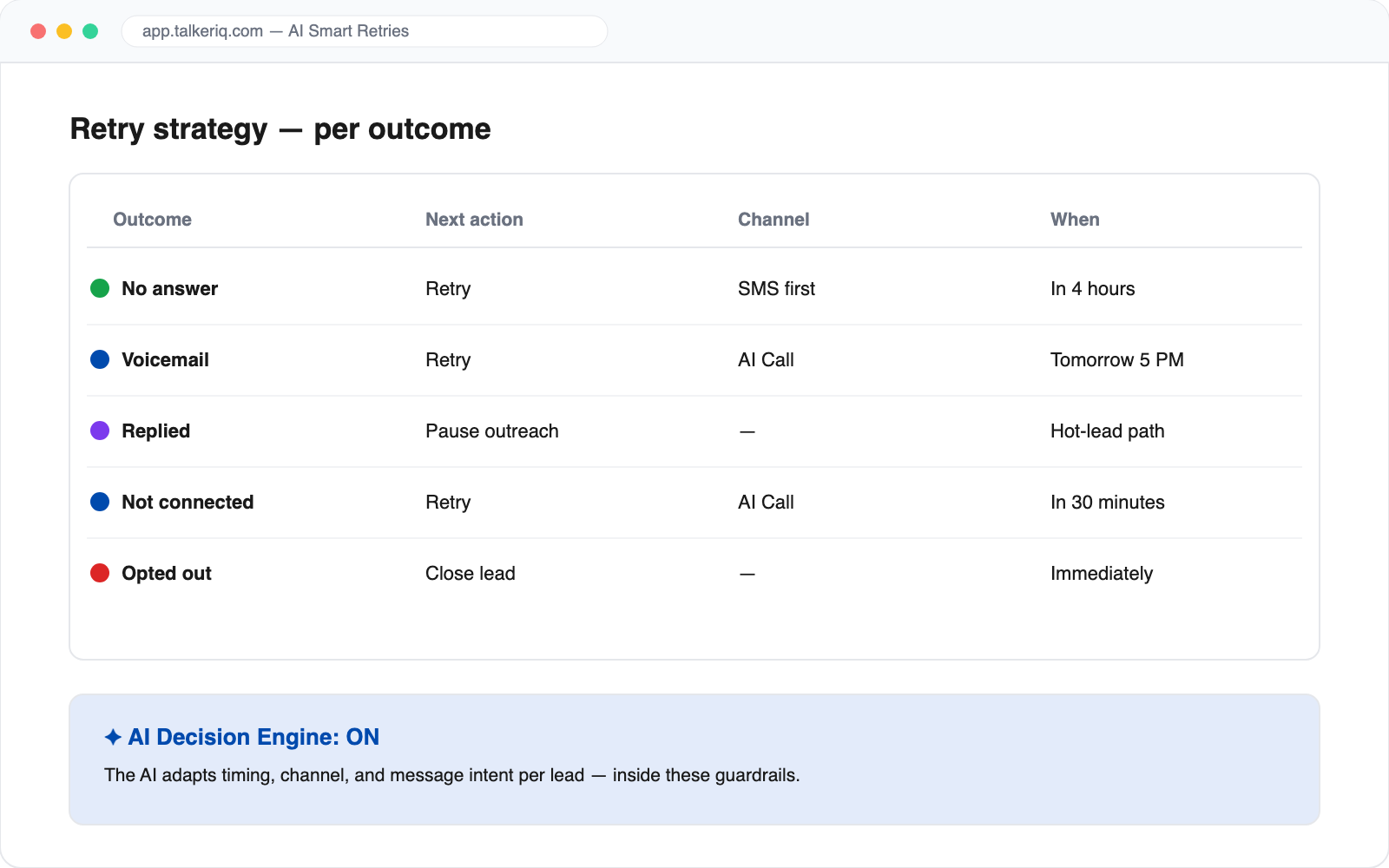
Most dialers redial on a timer. TalkerIQ reasons about each lead.
| Static retry rules (typical dialer) | TalkerIQ AI re-attempt engine | |
|---|---|---|
| Retry timing | Same fixed interval for everyone | Chosen per lead from the outcome, time of day, and attempt history |
| Channel choice | Always redial the phone | Switches between AI call and SMS based on what's most likely to get a response |
| Message intent | Same script every attempt | Adapts the intent of the next touch — nudge, value reminder, scheduling ask |
| Replied leads | Keep dialing anyway | Pauses outreach, cools down, or routes to a hot-lead path |
| Opt-outs | Manual list scrubbing | Closed out immediately across both call and SMS channels |
| Control | Edit cron-like settings | Full AI, full manual ladders, or AI within the guardrails you set |
You stay in control of how far the AI can go
The engine distinguishes voicemail from no-answer from "not connected" from a real reply — and treats each differently, aligned with your campaign's goal and context.
Prefer explicit control? Define exact ladders per outcome — attempt counts, intervals, channel switches — and see a preview table of precisely when each attempt will fire.
Whatever the engine decides, attempts only fire inside your campaign's calling windows and time-zone rules. Compliance guardrails are never optional.
Every decision is recorded on the contact's sequence timeline: which attempt, which channel, why, and what happened — so you can audit the AI's choices lead by lead.
After each attempt, the decision engine reviews the outcome, the lead's full attempt history, the campaign's goal, and your configured limits. It then picks the next action: retry now or later, switch from call to SMS (or back), change the message intent, cool the lead down, or close them out. Leads that reply are never blindly redialed.
Yes. Build the backbone in the visual flow builder (or let Spark draft it), and let the AI engine optimize the re-attempt details inside it. You choose the mix: fully manual ladders, fully AI, or AI within your guardrails.
It distinguishes answered calls, no answer, voicemail, calls that didn't connect, SMS replies, and opt-outs — and applies different follow-up behavior to each, per lead.
No. A reply changes the lead's state: the engine pauses automated outreach, applies a cooldown, or routes the lead to a hot-lead path for faster human or AI engagement.
Yes. Attempt caps, allowed channels, calling windows, and cooldowns are all guardrails you configure. The AI optimizes within them — never around them.
Yes. Contacts flagged Do-Not-Call or who opt out via call or SMS are closed out immediately across both channels, and no further attempts are scheduled.
Each contact's sequence journey shows every attempt and decision in order — channel, timing, and outcome — so the engine's behavior is fully auditable.
No. You can run campaigns on explicit rule-based retry ladders with a full preview of when each attempt fires, use the AI engine end-to-end, or mix both.