
"Call new leads within 5 minutes. If no answer, text them, wait a day, then try twice more in the evening." That's all Spark needs. TalkerIQ's AI campaign copilot turns plain English into a validated call-and-SMS sequence you can review, tweak, and launch.
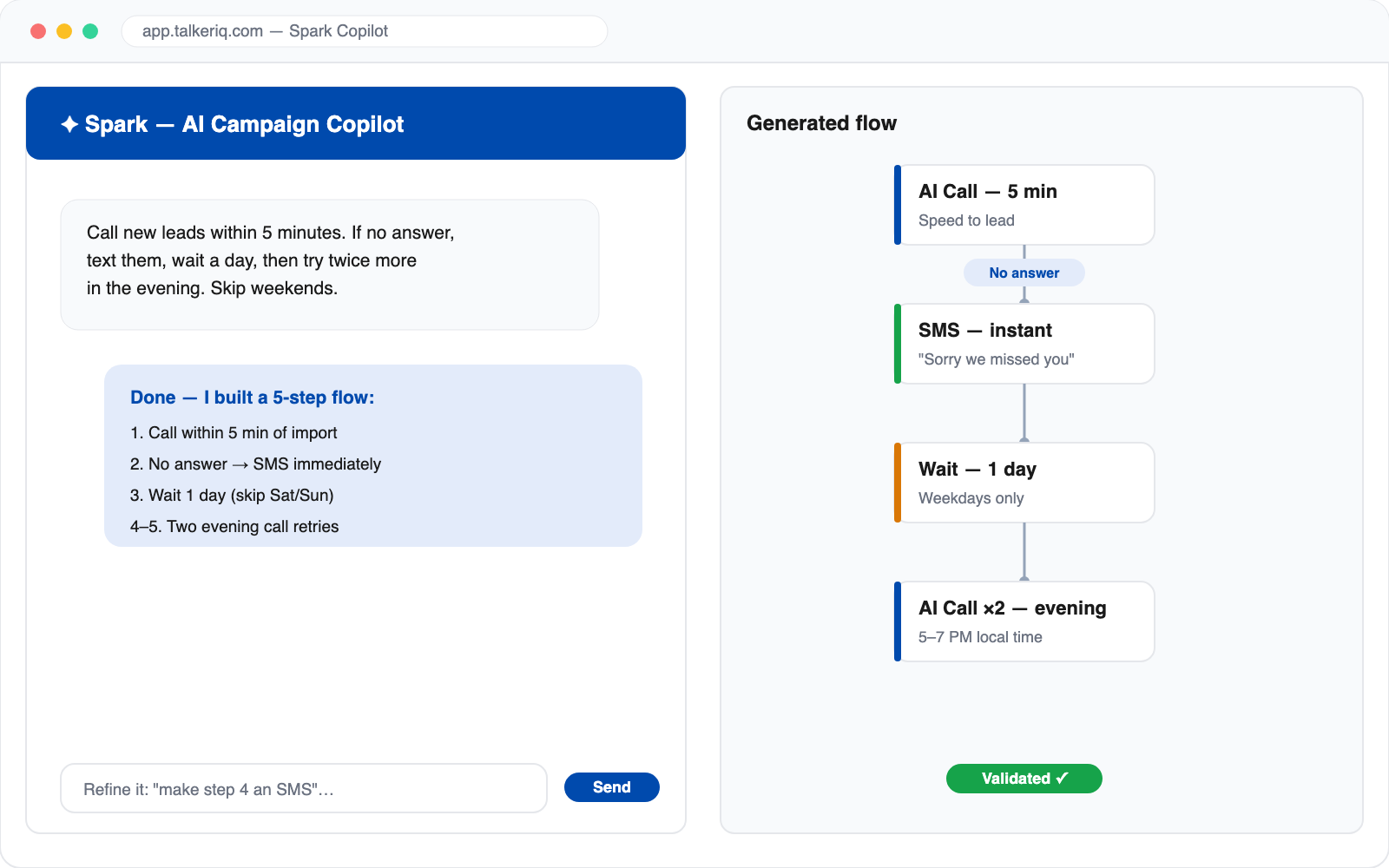
Spark handles the mechanics so you can focus on the message
Write your cadence the way you'd explain it to a colleague. Spark converts it into concrete steps: which channel, how long to wait, how many attempts, and what to do on each outcome.
Everything Spark produces passes the same validation as hand-built flows — no dead ends, no loops, no ambiguous branches. What you approve is what runs.
Not quite right? Keep chatting: "make the second attempt an SMS," "don't call after 7 p.m." Spark revises the flow and keeps your conversation history so you can iterate.
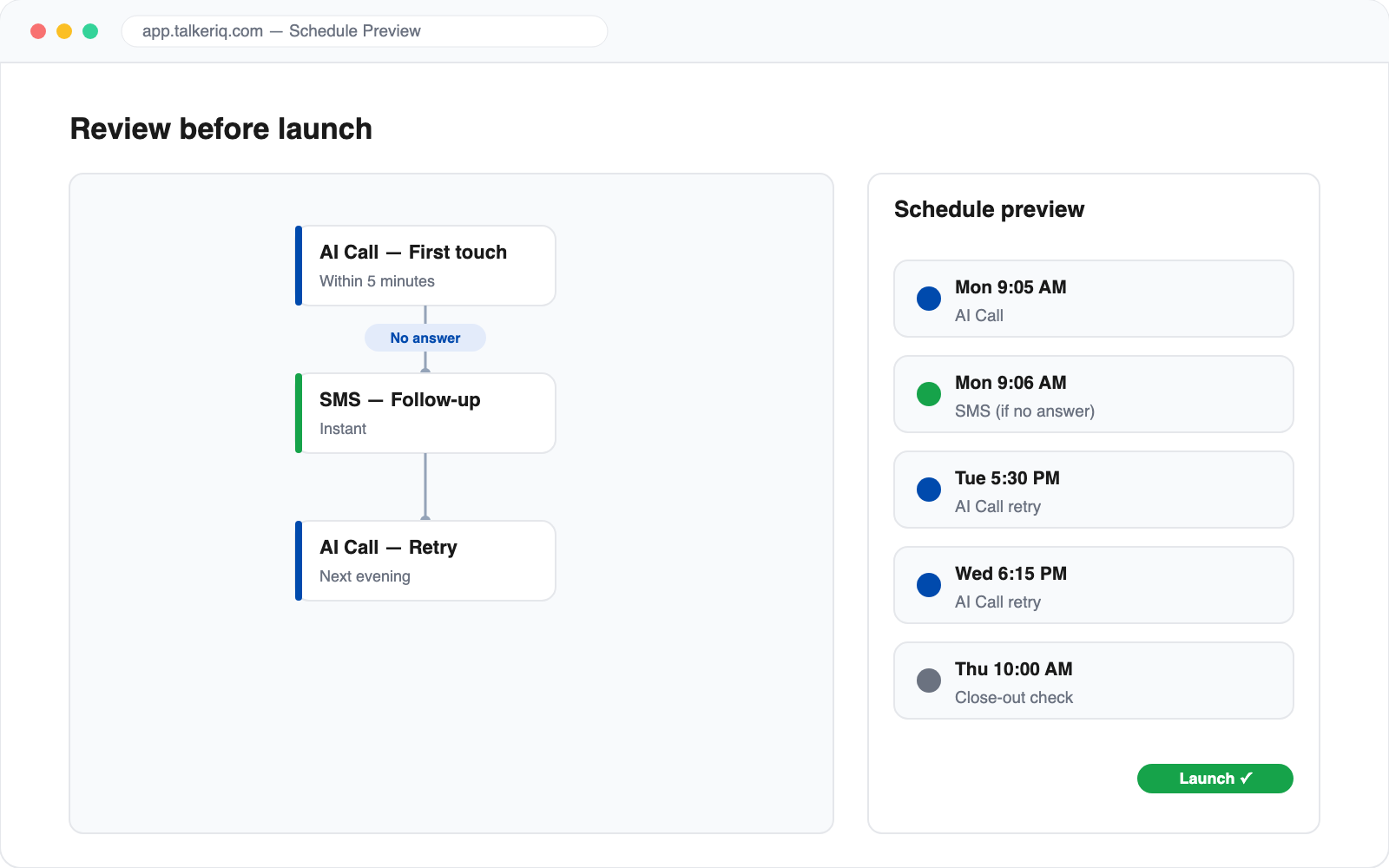
Spark's output lands on the visual flow builder canvas with a schedule preview — inspect every step and edge, adjust anything by hand, then launch.
Templates give you a fixed starting point; Spark builds the exact cadence you describe. It understands attempts, channels, wait durations, time-of-day constraints, and outcome-based branching — so "try twice by phone, then switch to text, but never on weekends" becomes a precise flow rather than a template you have to rework.
No — they work together. Spark drafts, you refine. Its output is a normal TalkerIQ flow: you can open it on the canvas, drag steps around, change conditions, preview the schedule, and run the launch checklist just like a hand-built campaign. Pair it with AI smart retries to let the platform optimize each lead's follow-ups after launch too.
Building a campaign with Spark takes three steps
Any outreach cadence made of AI calls, text messages, waits, and conditions — for example a speed-to-lead sequence, a multi-day no-answer ladder, or an SMS-first campaign with call fallback. Spark also sets retry behavior per outcome, like voicemail versus no answer.
No. Spark drafts; you decide. Every generated flow opens in the visual builder where you can edit steps by hand, preview the schedule, and only launch when it matches your intent.
Yes. Continue the conversation to revise the strategy — Spark keeps your chat history per campaign, so refinements build on what you already have instead of starting over.
No. Generated flows respect the campaign's business-hours and scheduling settings, and the schedule preview shows exactly when each attempt would fire so you can verify before launch.
Spark is part of the TalkerIQ campaign builder experience. Book a demo to see it build a live campaign from your own playbook.