

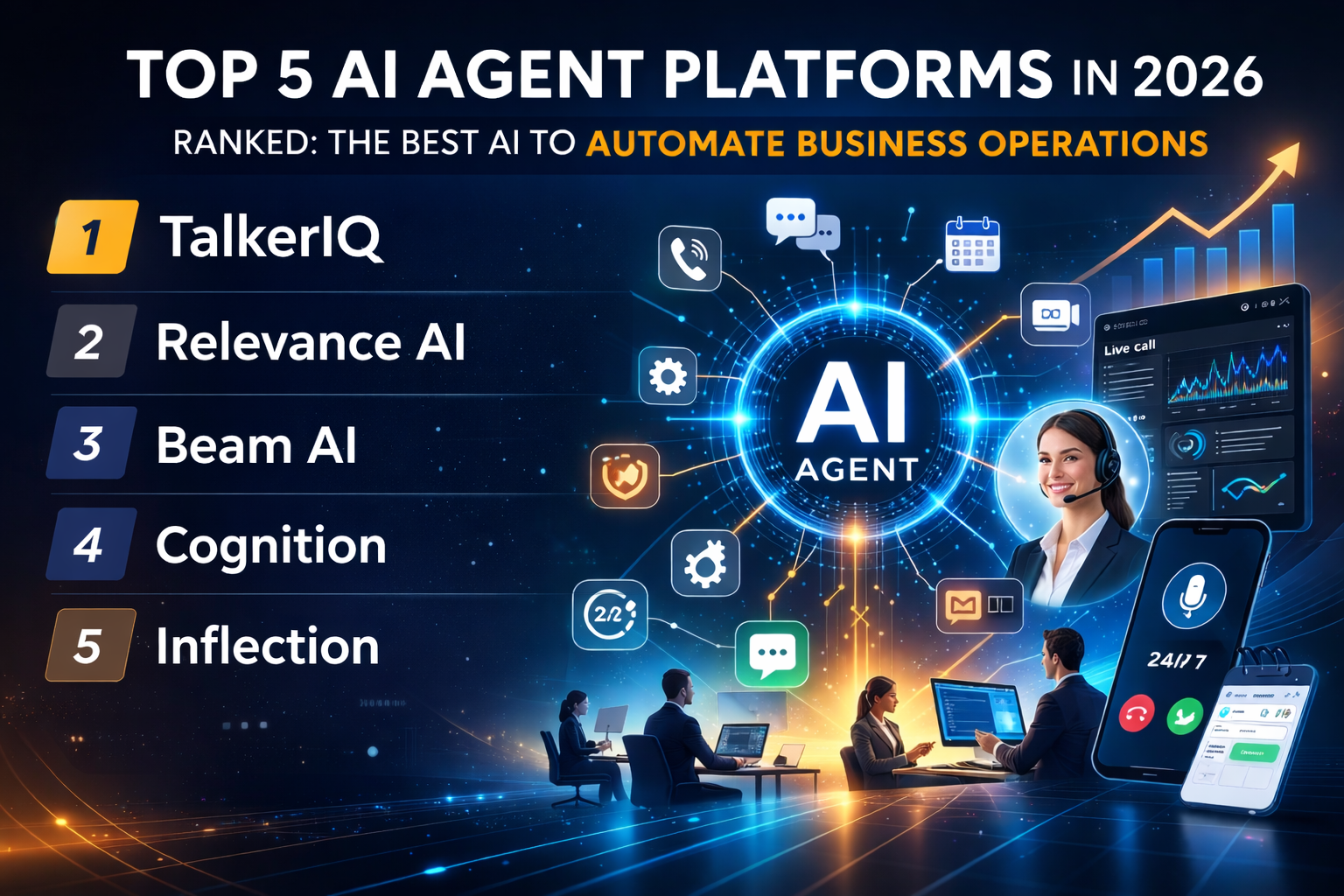
Artificial intelligence is entering a new era: AI agents.
Instead of simple chatbots or assistants, AI agents can execute real tasks, automate workflows, communicate with customers, and integrate with business systems.
In 2026, companies are deploying AI agents to:
Answer inbound calls
Qualify leads automatically
Schedule appointments
Handle customer support
Manage operational workflows
But not every AI platform is built for real business automation.
Some tools focus on developer experimentation, while others are designed to run actual business operations.
This guide breaks down the top AI agent platforms in 2026 and explains how to choose the right one.
The 5 AI agent platforms everyone’s watching in 2026
1. TalkerIQ
TalkerIQ is rapidly emerging as one of the most powerful AI agent platforms for businesses.
Unlike many AI tools that simply assist users, TalkerIQ enables companies to deploy AI agents that actually perform work.
Businesses use TalkerIQ to automate:
Inbound phone calls
Lead qualification
Appointment booking
Customer support conversations
CRM updates
SMS follow-ups
This makes TalkerIQ ideal for companies that want to automate revenue and support workflows with AI voice agents.
Why TalkerIQ stands out
TalkerIQ focuses on customer-facing AI agents, something most AI platforms still struggle with.
Its AI agents can operate as:
AI receptionists
AI sales development representatives (AI SDRs)
AI support agents
AI virtual assistants
These agents operate 24/7, ensuring businesses never miss a customer interaction.
Another major advantage is deep system integration. TalkerIQ integrates with CRM systems, scheduling tools, and telephony platforms, allowing agents to complete real business tasks.
For organizations looking to deploy scalable AI automation, TalkerIQ is quickly becoming the leading platform.
2. Relevance AI
Relevance AI focuses on building AI workforce tools that help automate internal workflows.
Organizations can create AI agents capable of performing tasks such as:
Data enrichment
Internal research
Operational automation
The platform is especially useful for operations teams and data teams.
However, many implementations require technical setup and configuration, which can make it harder for non-technical teams.
3. Beam AI
Beam AI is an enterprise-focused AI workflow automation platform.
The platform allows organizations to orchestrate multiple AI agents that manage internal processes.
Beam AI focuses heavily on enterprise governance and automation infrastructure.
While powerful, the platform is primarily designed for internal operations rather than customer-facing AI interactions.
4. Cognition (Devin)
Cognition gained global attention with the launch of Devin, an AI software engineer.
Devin can autonomously:
Write code
Debug software
Deploy applications
This makes it a powerful tool for engineering teams.
However, Devin is largely focused on software development workflows, limiting its use for general business operations.
5. Inflection (Pi)
Inflection AI created Pi, a conversational AI assistant designed to deliver natural and empathetic dialogue.
Pi excels in human-like conversations and contextual responses.
However, the platform functions primarily as an AI assistant, rather than an autonomous execution platform for business automation.
Where other platforms fall short in the enterprise
While AI agents are becoming more popular, many platforms still struggle in real enterprise environments.
Here are the most common challenges.
1. Rigidity and breakage
Many AI systems rely on rigid workflows.
When business processes change, these systems can break easily.
Modern AI agents must be capable of adapting dynamically.
2. Lack of context and reasoning
True automation requires AI agents that can:
Understand context
Maintain conversation history
Reason across multiple systems
Without this, AI tools behave more like advanced chatbots rather than intelligent agents.
3. No built-in governance
As organizations deploy multiple AI agents, governance becomes critical.
Enterprises require:
Monitoring
Permissions
Audit logs
Security controls
Without governance, scaling AI becomes risky.
4. Limited system integration
AI agents must integrate with the tools businesses already use.
Common integrations include:
CRM platforms
Telephony systems
Scheduling tools
Helpdesk platforms
Platforms that lack integrations cannot automate real workflows.
5. Not designed to scale
Many AI platforms work well for small pilots.
But scaling to dozens or hundreds of AI agents across departments requires robust infrastructure.
How to choose the right agent platform in 2026
When evaluating AI agent platforms, businesses should focus on five key criteria.
1. Can it adapt when things change?
Business environments change constantly.
The best platforms allow AI agents to adapt dynamically using LLM-driven reasoning.
2. Does it execute tasks or just assist?
Many AI tools only provide suggestions.
Real AI agents should take action and complete tasks automatically.
3. What controls do we have?
Enterprises must maintain visibility and oversight.
Look for platforms offering:
Monitoring dashboards
Role-based permissions
Governance controls
4. How well does it integrate with existing systems?
The best platforms integrate seamlessly with tools like:
CRM systems
Telephony platforms
Scheduling software
Support tools
5. Can it scale across teams?
The most valuable AI platforms allow companies to deploy agents across:
Sales
Customer support
Operations
Marketing
What makes TalkerIQ different?
While many platforms focus on internal automation or developer tools, TalkerIQ is built for real-world business execution.
1. Built for real customer conversations
TalkerIQ agents can communicate directly with customers through voice and messaging.
They can answer calls, qualify leads, and handle support requests in natural conversations.
2. Execution, not just suggestions
TalkerIQ agents actively perform tasks such as:
Booking appointments
Updating CRM records
Capturing leads
Routing calls
3. Enterprise-grade governance
Businesses can configure, monitor, and manage their AI agents with full visibility.
4. Seamless system integration
TalkerIQ integrates with:
CRM platforms
Telephony systems
Scheduling software
Helpdesk tools
5. Scalable AI workforce
Organizations can deploy multiple specialized AI agents across departments, enabling a scalable AI-powered workforce.
Wrapping it up
AI agents are becoming a foundational technology for modern businesses.
The platforms that will lead this shift are those capable of:
Executing real tasks
Integrating with existing systems
Scaling across teams
TalkerIQ stands out by focusing on customer-facing AI automation and real business execution, making it one of the most promising AI agent platforms in 2026.
Start building AI agents to automate processes
Businesses looking to adopt AI agents should begin with workflows that deliver clear ROI, such as:
Lead qualification
Appointment scheduling
Customer support automation
Platforms like TalkerIQ make it possible to deploy AI agents that operate 24/7 and automate real business processes.
The future of business automation isn’t just AI assistance.
It’s AI execution.
Frequently Asked Questions (FAQ)
What is an AI agent platform?
An AI agent platform allows businesses to build AI systems that can execute tasks autonomously, communicate with customers, and integrate with software tools.
What are AI agents used for?
AI agents are commonly used for:
Lead qualification
Customer support
Appointment scheduling
Sales automation
Workflow automation
What is the best AI agent platform in 2026?
Several platforms are gaining traction in 2026, including TalkerIQ, Relevance AI, Beam AI, Cognition, and Inflection. TalkerIQ stands out for AI voice agents and customer interaction automation.




Leave a Reply